

Giant Magellan Telescope and Coquimbo Regional Government Sign Strategic Partnership to Strengthen Chile’s Astronomy Industry
New partnership advances regional economic growth through astronomy and positions Coquimbo region as Chile’s global hub for science, technology, and innovation
PASADENA, Calif., April 17, 2026 (GLOBE NEWSWIRE) -- Today, the Giant Magellan Telescope and the Coquimbo Regional Government announced a strategic collaboration to advance Chile’s astronomy industry, drive regional economic growth, and position the Coquimbo region as a global hub for science, technology, and innovation. At the heart of this partnership is Chile’s first national visitor and education center for astronomy, designed in partnership with Exploratorium to bring the excitement of discovery, technological innovation, and astrotourism directly to the public.
“This partnership positions the Coquimbo Region at the forefront of an industry that is shaping the future of science, technology, and opportunity,” said Governor Cristóbal Juliá. “By working with the Giant Magellan Telescope, we are creating high-quality jobs, advancing innovation, and establishing our region as a leader in one of the most important industries in the world, all while connecting Chileans with the incredible discoveries happening from our skies.”
To support public engagement and communicate the progress of the partnership, the Giant Magellan Telescope and the Coquimbo Regional Government have launched a dedicated website at coquimbo.giantmagellan.org. The site will serve as a central platform to share updates, highlight regional impact, and showcase the significance of the collaboration.
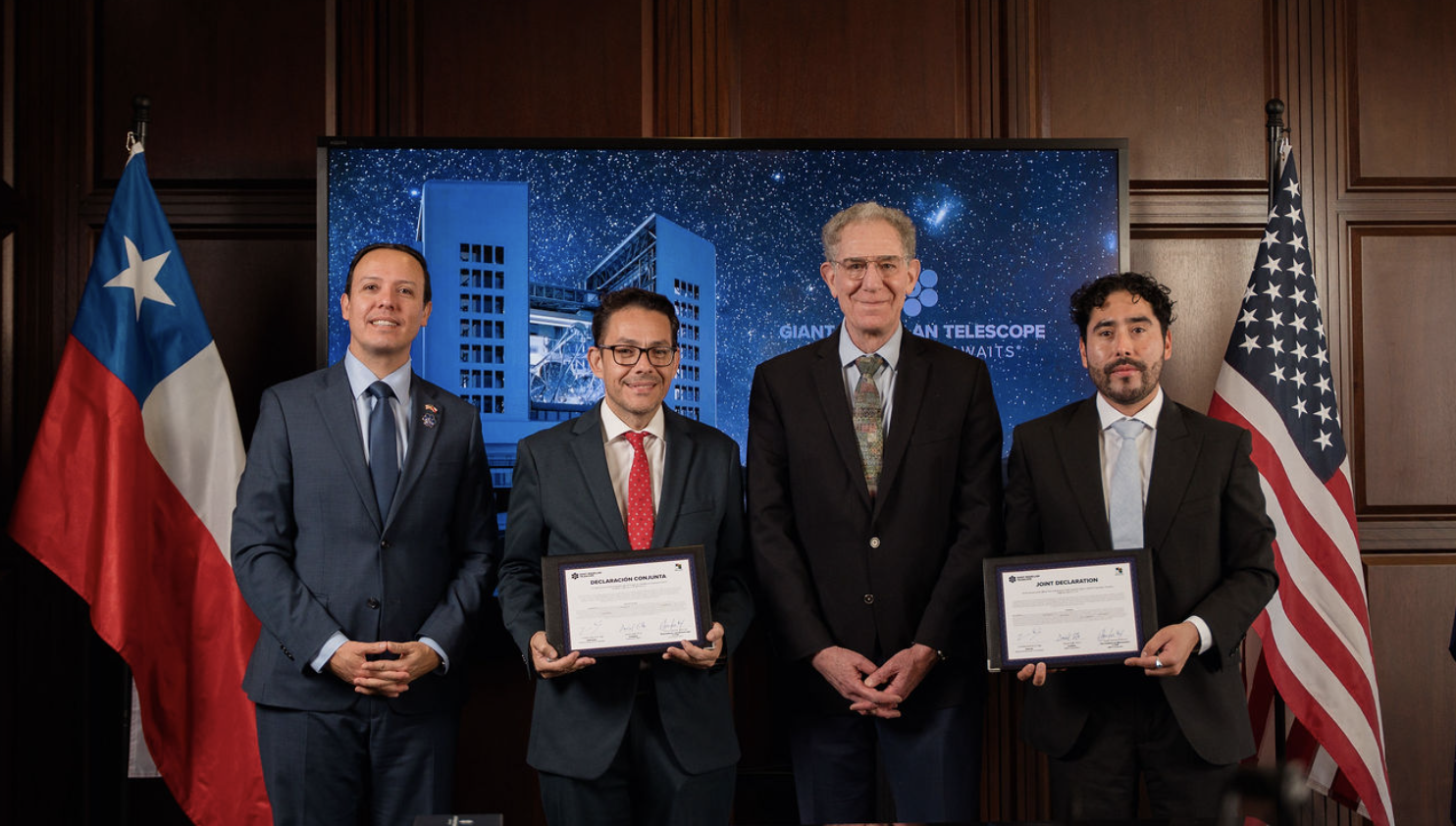
The agreement was formalized during the Governor’s official visit to the Giant Magellan Telescope’s headquarters in Pasadena, where he met with the observatory’s international leadership, including President Daniel Jaffe, and with the attendance of the Chilean Consul in Los Angeles, Mr. Francisco Leal. The signing reflects a growing alignment between regional leadership and one of the most significant international scientific infrastructure projects underway today.
Chile is home to the majority of the world’s astronomical infrastructure and, by the 2030s, will host nearly 70 percent of it. The Coquimbo Region plays a central role in that leadership, hosting major observatories and operational centers, including the Vera C. Rubin Observatory, the world’s newest and most advanced survey telescope. The region’s growing infrastructure, observatory operators, and scientific workforce will also be celebrated through the proposed national visitor and education center, providing public access to Chile’s astronomy industry, technological innovations, and scientific discoveries.
“The Giant Magellan Telescope represents a multi-billion-dollar international investment in Chile, and this partnership ensures that its benefits extend well beyond the observatory site,” said Daniel Jaffe, President of the Giant Magellan Telescope. “Together, we are establishing a long-term foundation that supports scientific leadership, economic growth, expanded opportunity across the region, and a public-facing hub that will connect people directly with Chile’s world-class astronomy industry.”
Located at Las Campanas Observatory, the Giant Magellan Telescope is part of a new generation of “extremely large telescopes” that support a world-class scientific, engineering, and industrial ecosystem. Over nearly a century of operations, the observatory will anchor sustained demand for expertise in engineering, construction, data systems, and scientific research.
As part of this partnership, the Giant Magellan Telescope will establish its primary operations base in the Coquimbo Region, creating a central hub for telescope operations, data systems, and scientific activity. Within this campus is a flagship visitor and education center, a first-of-its-kind national landmark in Chile, developed in collaboration with the Exploratorium, a global leader in interactive science education. Envisioned as a world-class destination, the center will showcase technological innovation, and scientific discoveries, support workforce development, and promote astronomy tourism, making Chile’s leadership in the industry visible and inspiring to all.
“Together we’re creating a place where people can gather and directly experience the power of science and engineering,” said Anne Richardson, Chief Experience Officer at the Exploratorium. “Drawing on decades of experience creating spaces that spark curiosity and learning, we’re proud to partner on this effort. This center will connect communities to Chile´s astronomy research, inspire future generations and make discovery tangible and accessible to all.”
For regional commerce, the partnership will also establish the Port of Coquimbo as the main logistics hub for the project, supporting the transport of major telescope components and infrastructure from international partners as the observatory is constructed over the next few years. This coordinated approach strengthens regional supply chains and positions the Coquimbo region as a critical entry point for global scientific infrastructure.
“This is about connecting the development of the telescope with regional growth,” said Oscar Contreras, Vice President and Chile Representative for the Giant Magellan Telescope. “Through this partnership, we are strengthening local capabilities, expanding opportunities for Chilean talent, and ensuring that the benefits of this global scientific investment are realized within the communities closest to it.”
A central pillar of the partnership is the protection of Chile’s astronomical observing conditions as a strategic national resource, one that is becoming increasingly rare worldwide. Ensuring long-term astronomical site protection is essential for maintaining Chile’s leadership in a global industry that depends on stable, high-quality skies.
This strategic partnership establishes the Coquimbo Region as a global hub for astronomy, linking the operations center, the first-of-its-kind national landmark visitor center, and the protection of Chile’s world-class observing sites, while engaging the public in Chile’s astronomy industry. Together, these efforts will expand Chile’s leadership in the astronomy for generations to come.
About Giant Magellan Telescope
The Giant Magellan Telescope is the future of ground-based astronomy. Using seven of the world’s largest mirrors, the 25.4-meter telescope will deliver the most detailed images of the Universe ever taken. It will uncover the cosmic mysteries of dark matter, investigate the origins of the chemical elements, and search for signs of life on distant planets. The Giant Magellan is the work of the GMTO Corporation, a 501(c)(3) nonprofit and international consortium of 16 universities and research institutions including the University of Arizona, Carnegie Institution for Science, The University of Texas at Austin, Korea Astronomy and Space Science Institute, University of Chicago, Massachusetts Institute of Technology, São Paulo Research Foundation, Texas A&M University, Northwestern University, Harvard University, Astronomy Australia Ltd., Australian National University, Smithsonian Institution, Weizmann Institute of Science, Academia Sinica Institute of Astronomy and Astrophysics, and Arizona State University. The observatory is under construction in Chile and will be completed in the 2030s.
About the Coquimbo Region
The Regional Government of Coquimbo is the body responsible for promoting the economic, social and territorial development of the region, promoting public investment, decentralization and the improvement of the quality of life of its inhabitants through strategic initiatives and collaborative work with different public and private actors.
About the Exploratorium
The Exploratorium is a portal to the astonishing scientific phenomena that animate our world and shape our actions. We create extraordinary learning experiences that ignite curiosity, upend perceptions, and inspire brave leaps forward. Since 1969, the Exploratorium’s museum in San Francisco has been home to a renowned collection of exhibits that draw together science, art, and human perception, and that have changed the way science is taught. Our award-winning programs provide a forum for the public to engage with artists, scientists, policymakers, educators, and tinkerers to explore the world around them. We celebrate diversity of thought, inspired investigation, and collaboration across all boundaries.
Media Contacts
Sandra Gurovich
Press Officer Chile, Giant Magellan Telescope
sgurovich@gmto.org
Roberto Rojas Galvez
Press Officer, Gobierno Regional de Coquimbo
rrojas@gorecoquimbo.cl
Lyndsey Roach
Exploratorium Press Office
media@exploratorium.edu
A photo accompanying this announcement is available at https://www.globenewswire.com/NewsRoom/AttachmentNg/7412131e-214d-463c-add6-46139a31a9e7


Giant Magellan Telescope and Coquimbo Regional Government Sign Strategic Partnership

From left to right: Chilean Consul in Los Angeles, Mr. Francisco Leal; Governor of Coquimbo, Mr. Cristobal Juliá; Giant Magellan Telescope President, Daniel Jaffe; Giant Magellan Telescope Vice President and Representative in Chile, Oscar Contreras.
Legal Disclaimer:
EIN Presswire provides this news content "as is" without warranty of any kind. We do not accept any responsibility or liability for the accuracy, content, images, videos, licenses, completeness, legality, or reliability of the information contained in this article. If you have any complaints or copyright issues related to this article, kindly contact the author above.
